Introducing Our Horoscope Engine
Our horoscope engine is a deterministic astrology runtime designed for real production products, not novelty text generation. It combines Swiss Ephemeris computation, strict factor activation, and editorial rendering so your app receives stable, explainable, and premium report output.




What You Are Building On
At runtime, the engine calculates real celestial state and assembles meaning from activated astrological factors. For identical payloads, outputs remain byte-for-byte stable. When personalization inputs are provided, house-level and birth-context vectors activate to produce user-specific differences.
This gives your team:
- Predictable outputs for testing, QA, and caching — identical requests always return identical JSON.
- Explainable report composition through
factor_detailstraces on every section. - A clean path from lightweight sign reports to premium personalized reports.
- Period-aware depth — daily (5-6 factors), weekly (10), monthly (11), and yearly (13) factor stacks with explicit weights.
Architecture at a Glance
Full Engine Architecture
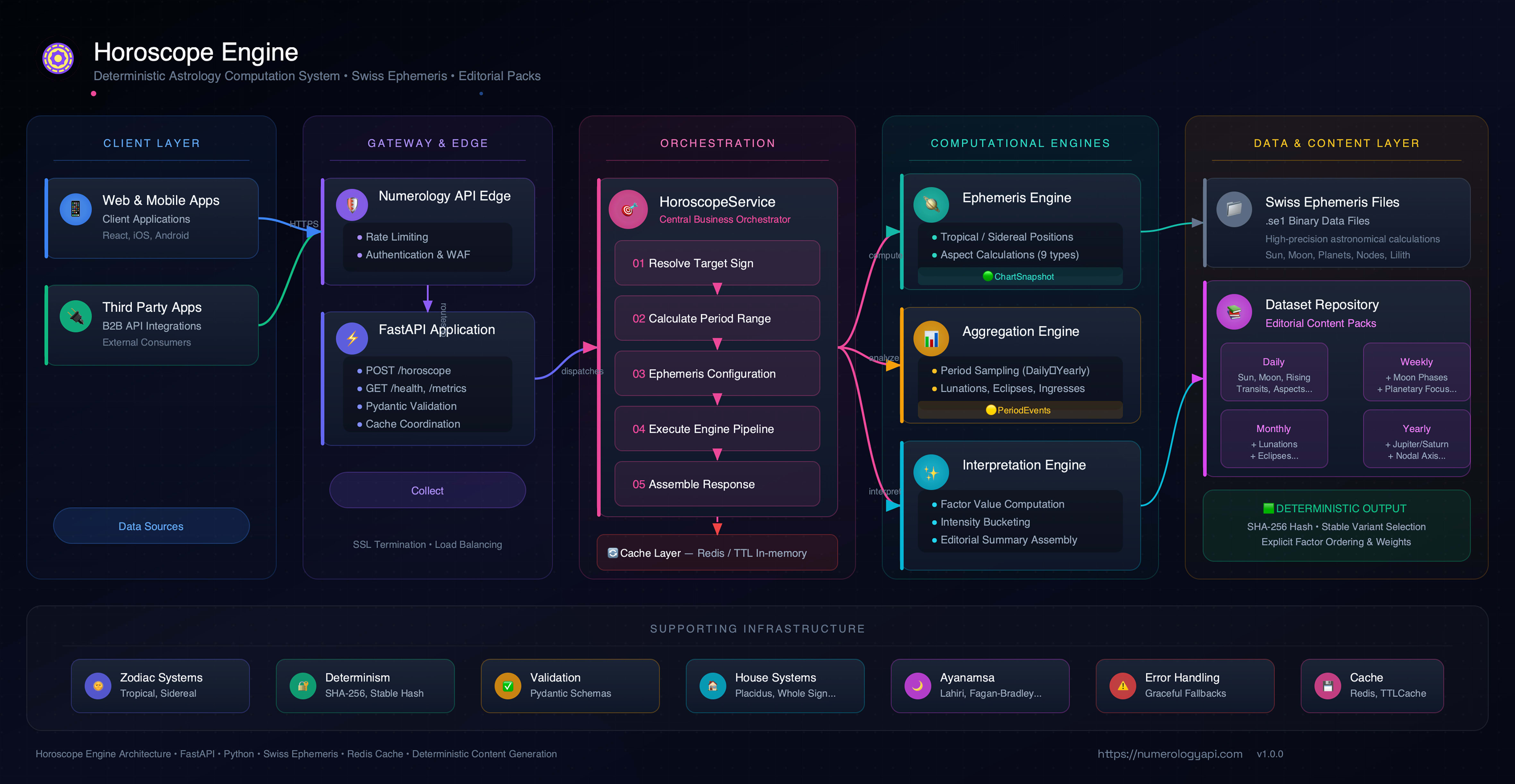
Request-to-Response Architecture

Deterministic Pipeline
- Gateway validates authentication, quotas, and request policy.
- Request contract validation enforces accepted schema and options.
- Engine resolves sign source, period window, and ephemeris configuration.
- Swiss Ephemeris computes positions, aspects, and houses (when eligible).
- Aggregation layer samples the period, extracts events (aspects, ingresses, stations, lunations, eclipses), and ranks drivers.
- Interpretation engine maps factor specs to editorial content using fixed order, explicit weights, and stable hash variant selection.
- Editorial engine renders section narratives from V2 content packs with period-specific arc composition (opening → shift → outcome).
- Gateway returns engine payload plus enterprise wrappers (
_enterprise,_api_metadata_) for integration metadata.
Determinism Guarantees
Determinism is not an accident — it is enforced at every layer:
| Guarantee | Enforcement Mechanism |
|---|---|
| Same payload → same factors | Explicit factor ordering per period + fixed weights |
| Same factors → same content variants | SHA-256 stable hash index selection |
| Same variants → same phrasing | Deterministic phrase cycling from V2 content packs |
| Same phrasing → identical JSON | Editorial rewrite consistency + adjacent-section breath-line deduplication |
This means you can hash two independent requests with the same body and get the same output, enabling reliable caching, QA regression testing, and reproducible debugging.
Public vs Personalized Reports
Both are production-valid modes. The difference is not quality; it is activation depth.
Public Mode (Sign-Based)
Provide only a zodiac sign and date. The engine produces a stable, shared reading for all users with that sign in that period.
- Great for broad audience feeds and cost-efficient caching (12 signs × 4 periods × 365 days = ~17,520 unique daily caches)
- No house calculations —
rising_sign,house_cusps, and bodyhouseassignments arenull - Strong fit for rapid rollout, magazine-style horoscopes, and freemium tiers
Personalized Mode (Birth-Aware)
Provide birth context (birth_time, coordinates, timezone) to activate deeper vectors. Two users with the same sign can receive different editorials because house placement and rising sign change the factor scoring.
- Required fields:
birth_time(HH:MM) +birth_latitude+birth_longitude - Unlocks: rising sign, 12 house cusps, planet-to-house assignments, and house-focus factors (
daily_house_focus,weekly_house_focus,monthly_house_focus,yearly_house_focus) - Best for premium subscriptions and high-retention experiences
- Supports richer app modules and personalization funnels
Factor-Driven Editorial Model
The engine is driven by explicit factor stacks — deterministic interpretation drivers computed from celestial snapshots and period aggregation. Each period has a defined factor order and explicit weights.
Factor Stacks by Period
| Period | Factor Count | Key Drivers |
|---|---|---|
| Daily | 5-6 | sun_in_sign, moon_in_sign, transits_archetypes, aspects, daily_house_focus |
| Weekly | 10 | weekly_moon_phase, planetary_focus, retrograde_archetypes, weekly_theme_archetypes, weekly_house_focus |
| Monthly | 11 | monthly_lunation_archetypes, eclipse_archetypes, outer_planet_focus, monthly_theme_archetypes, monthly_house_focus |
| Yearly | 13 | jupiter_in_sign, saturn_in_sign, nodal_axis, yearly_house_focus, yearly_theme_archetypes |
Additional report families layer dedicated factor stacks: - Planet: planet_core_archetypes, planet_condition_archetypes, planet_house_focus, planet_sign_archetypes - Birthday: solar_return_tone, birthday_year_reset, natal_sun_house_year_theme - Aspect: aspect-led stacks with computed or overridden dominant aspect - Transit: transit-led stacks with computed or overridden dominant transit archetype
Each factor carries an explicit weight (e.g., moon_in_sign: 1.15 daily, yearly_theme_archetypes: 1.30 yearly) that influences section scoring and intensity derivation.
This model avoids random prose drift and keeps editorial tone tied to computed drivers with full traceability in factor_details.
Daily Personalized App Stats (Main Horoscope)
For daily personalized mode, the engine returns rich app-ready stats blocks at data.daily_personalized_stats. These are ideal for dashboard cards and summary widgets.


Activation trigger: period=daily and personalized birth request includes both birth_time and coordinates.
Key blocks:
overall_pulse— composite daily vitality scorearchetype_scores— eight-dimension breakdown (wisdom,creativity,confidence,intuition,allure,romance,career,emotions)harmony_discord— top 4 harmonious and top 4 discordant sign driverselemental_balance— fire/earth/air/water distributionmomentum_channels— planetary momentum signals
Payload density control:
daily_stats_detail: "full"for complete chart data with confidence tiers per blockdaily_stats_detail: "compact"for lighter client payloads (ideal for mobile widgets)
Request Design Highlights
The engine supports clear, typed controls for astrological configuration and rendering behavior. Common options include:
| Field | Type | Purpose |
|---|---|---|
period | string | daily, weekly, monthly, yearly |
sections | array | Life areas to include (e.g., general, career, love_singles) |
sign / birth | string / object | Sign source (public vs personalized) |
target_date | string | Explicit date anchor (YYYY-MM-DD) for reproducibility |
zodiac_system | string | tropical or sidereal |
ayanamsa | string | Sidereal offset system (lahiri, fagan_bradley, etc.) |
house_system | string | placidus, whole_sign, equal, koch |
node_type | string | true (actual) or mean (average) lunar node |
tenant_id | string | Cache namespace isolation for multi-tenant or A/B scenarios |
Response Shape Guarantees in the Gateway
Gateway report responses pass through engine data and append wrappers:
_enterprise— plan tier, quota, and rate-limit metadata_api_metadata_— endpoint info, supported languages, and request context
For engine-backed report endpoints, _api_metadata_.supported_languages reflects all 26 supported languages:
{
  "_api_metadata_": {
    "supported_languages": [
      "en", "fr", "es", "de", "pt", "ja", "hi", "ar",
      "ru", "tr", "it", "pl", "nl", "id", "ko", "th", "ro",
      "ur", "gu", "bn", "vi", "ta", "te", "mr", "pa", "zh"
    ]
  }
}
Language and Translation Policy
Live engine-backed report endpoints (/api/v1/horoscope/reports/*, /api/v1/birth-chart) support all 26 languages. Non-English responses are translated on the fly by the translator helper at the API boundary — self-hosted LibreTranslate by default, with DeepL BYOK, MyMemory, or Google selectable per request via the translator query parameter or the X-Translator-Provider header (DeepL requires your own API key through the X-Translator-Api-Key header). The translated provider used for a response is reported under _api_metadata_.translation_provider.
Content Pipeline: V2 Content Packs
Editorial content is sourced from structured V2 content packs in the engine's content repository.
At runtime, the content repository selects variants deterministically via stable hash selection with a four-level fallback chain:
- Exact match (factor_type + factor_value + intensity)
- Any value for factor_type (factor_type + intensity)
- Any factor in section (section + intensity)
- Section fallback template
This structure ensures editorial variety across intensities while preserving reproducibility for the same seed.
Trust Model: Closed Core + Open Source Lite
Our main production engine is closed-source and optimized for enterprise reliability, depth, and managed operations. It includes:
- Full house-aware personalized reports (all periods)
- Birthday cycle reports with solar return factors
- Planet, aspect, transit, house, and planet-house report suites
- Natal birth chart with configurable SVG wheel rendering
- Redis caching, metrics, health checks, and horizontal scaling
To support indie astrologers and developer evaluation, we also provide the open-source lite engine:
Use OpAstro to evaluate engine quality, explore factor computation logic, and verify Swiss Ephemeris integration. Scale to NumerologyAPI enterprise routes for richer report layers, broader endpoint coverage, and managed production operations.
Integration Path
- Start with public sign-level reports — daily/weekly/monthly/yearly using
signonly. No birth data required. Cache efficiently. - Add personalized birth fields — supply
birth_time+ coordinates to unlock differentiated editorials with house-aware factors. - Layer specialized report families — planetary, aspects, transits, and house endpoints for deeper product surfaces.
- Add natal endpoints — full birth chart JSON + SVG wheel for visualization and advanced astrology workflows.
- Optimize with sections — request only the
sectionsyour UI needs (e.g.,["general", "career"]) to reduce payload size. - Use
tenant_idfor cache isolation — separate free/premium tiers or A/B test variants without cache pollution.
Caching Strategy
| Mode | Cache Efficiency | Strategy |
|---|---|---|
| Public (sign-only) | High — ~17,520 unique daily caches | Pre-warm next day; TTL 1-4 hours |
| Personalized (birth-aware) | Lower — unique per user | Per-user cache keys; TTL 24 hours; Redis recommended |